The Light We’re Missing: Tony Macken on Why Daylight Matters More Than We Think
We rarely think about daylight until we are missing it.
We notice the lift that comes with a bright morning after weeks of grey skies. We instinctively choose the table beside the window. After hours in an office or meeting room, we find ourselves wanting to step outside.
For Tony Macken, Managing Director of Daylight.ie, those everyday behaviours point to something much bigger.
Recently recognised by the All-Ireland Business Foundation as Business All-Star Thought Leader in Daylight Awareness 2026, Tony has spent years studying our relationship with daylight and questioning whether modern life is slowly disconnecting us from something our bodies naturally seek.
His journey into the subject, however, began almost by accident.
Going Down the Daylight Rabbit Hole
Tony has been self-employed since age 28 and in 2017, he found himself looking for a new challenge. An opportunity arose to take over a small lighting company, despite his knowledge of lighting at the time being, as he jokes, limited to being able to “wire a plug”.
As the industry changed and LED technology became increasingly dominant, Tony knew the business needed to evolve. In October 2018, he travelled to the International Lighting Exhibition in Hong Kong looking for something new.
There, he discovered Ewindow.
Initially, what caught his attention was the simple idea of bringing the feeling of the outdoors into an indoor space. But the product opened the door to a subject that would eventually become far more important to Tony than lighting alone.
“I had no idea that I was going to go down the rabbit hole that I have gone down in terms of studying daylight, realising its importance.”
That curiosity led Tony into the study of circadian rhythms and the role light plays in regulating our daily patterns. The more he learned, the more conscious he became of how little natural daylight, many of us actually experience in our day to day lives.
We awaken indoors and we travel to work or even work from home. We spend most of the day under artificial lighting. During an Irish winter, many will leave home in darkness and return home in darkness, never getting exposed to any daylight. 150 Years ago we spent 90% of our awakened time outdoors. Today, we spend 8% of that time outdoors.
Yet Tony believes our instinctive behaviour tells us what our bodies want.
“If you go into a bar or restaurant and you’re greeted by the host, they might say, ‘I have a couple of tables over here and actually I have one table by the window.’ Inevitably, where will you go?”
The window.
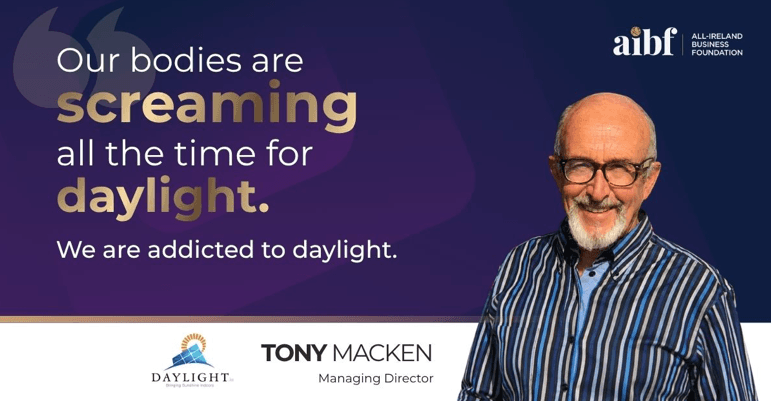
“Your body is screaming all the time for daylight. We are addicted to daylight.”
The Simple Case for Getting Outside
For all the technology and science involved in Tony’s work, one of his strongest messages is remarkably simple.
Get outside.
Morning daylight has become a particular focus of his studies. He believes we need to become much more conscious of experiencing natural outdoor light rather than assuming that simply sitting beside a window provides the same experience.
And in Ireland, there is another misconception he is keen to challenge.
It does not need to be sunny.
During our conversation, the Dublin sky outside was grey and the rain was falling. Tony’s advice did not change.
“Even on a cloudy day, you’re still getting all that good light. We can’t see the red rays of the sun, but they are there. Its these red rays that feed our mitochondria, the energy batteries in our cells”
It is this understanding of our connection with the outdoors that has also shaped the development of Ewindow. The technology is designed to mimic the sun’s performance indoors. Tony describes the concept simply:
“We’re bringing the outdoors indoors.”
For him, some of the most interesting possibilities lie in places where people may have limited opportunities to get outside.
Nursing homes are one example.
Some residents may spend the vast majority of their lives within the same building, making the quality of that indoor environment particularly important.
Tony explains it simply. “If we can create correct daylight conditions inside the nursing home, it will regulate the body clock of the residents, thereby reducing anxiety and improving sleep patterns to provide a better quality of life and reduce the burden of care on the Director of Nursing”
He emphasizes similar opportunities exist in healthcare, education and the workplace, where people spend a significant proportion of their day in areas devoid of any natural daylight.
The Business Case for Daylight
For Tony, the importance of the workplace environment became particularly clear through a conversation with a friend who had recently commenced a new corporate role.
When he met her several months later, she advised him of her new role in another company.
Tony was surprised and asked what had happened.
Her response was ….. ‘I just hated my office. there was no daylight there’
He was interested in noting that there was no issue with her salary. Neither was there a problem with any bullying or sexual harassment. The lack of Correct Daylight conditions was the underlying issue, leading to the inconvenience and expense of hiring a replacement.
Her office environment had simply become somewhere that she could not perform to the best of her ability and it was causing her unnecessary stress.
The story stayed with Tony because businesses invest heavily in attracting and retaining good people. Salaries, benefits, technology, culture and career development can all receive significant attention but the simple matter of daylight is neglected
He also makes the point that ….. "Despite spending eight hours a day at work, employees are frequently placed in environments completely devoid of natural light—a factor all too often overlooked."
For business leaders, Tony believes that Correct Daylight Conditions deserves greater consideration.
His research explores how natural daylight directly impacts workplace performance, learning, staff retention, and absenteeism. By reducing workplace errors and accidents, optimized lighting ultimately yields significant financial savings.
It has also led him to question whether modern building design is overly fixated on efficiency alone—with lighting being a prime example.
While energy costs and sustainability are undeniably important, Tony argues that the conversation shouldn't end with how little energy a fitting consumes. We must also evaluate the quality of the environment created for the person working beneath it.
"We're so focused on cutting costs and energy that we overlook the impact of poor-quality LED lighting," he explains. "Technological advancement is outpacing medical guidance."
Tony isn't anti-LED; Ewindow itself relies on the technology. Rather, his point is that innovation can take many paths and energy efficiency must be balanced with human experience.
Ultimately, it poses a fundamental question for employers and designers: "Are we creating spaces that work for the building, or spaces that work for the people inside it?"
From Business Owner to Daylight Advocate
What began as an entrepreneur searching for a new direction has gradually become something much more personal.
Tony no longer sees his role as simply introducing businesses and organisations to a lighting technology.
Education has become central to what he wants to achieve.
“I see this as very much part of my role. Rather than just introducing people to Ewindow, I need to share what I have learned and educate people about how essential daylight is our lives.”
One of his key ambitions is to share this message with Transition Year students—helping young people appreciate the vital role daylight plays and empowering them to stay mindful of the environments where they learn, work, and spend their time.
He also intends to continue his own education, including further study to become certified in Quantum Circadian Biology.
His recognition as Business All-Star Thought Leader in Daylight Awareness 2026 has given that mission further momentum.
For Tony, the accreditation provides independent recognition of the work he has done to date, while strengthening the trust surrounding his message.
“Being associated with a strong National Brand like AIBF also gives confidence to both myself and our customers”
There is something fitting about where Tony’s journey has taken him.
He originally travelled to Hong Kong seeking new opportunities in lighting, but what he discovered fundamentally transformed how he viewed light itself.
Today, his message extends far beyond a single product or business. It prompts us to reflect on how much of modern life unfolds indoors, urges employers to rethink the environments they build for their workforce and challenges the notion that efficiency alone determines a building's success.
Most of all, it calls our attention to something so ordinary we take it for granted: …..Daylight
Even on the greyest Irish morning, Tony’s advice remains refreshingly simple:
…….Go Outside…..